The material presented in this post is my interpretation from two units I am currently studying at the University of Canberra: Sport Coaching Pedagogy and Motor Control & Skill Acquisition. Any errors posted here are entirely my own.
I’ve been learning and teaching Mambo which is a particular dance style of Salsa for close to 7 years. Mambo has its origins in New York City. I’ve been very fortunate to have been trained by Raquel Paez who is the director of the Salsabor Dance Company here in Canberra. She is a technique driven coach which may not sound like its much fun, but learning technique from the ground up does give you the freedom to explore options within the genre and with that freedom does in fact come fun. Therefore, this post will deal with how to structure, plan, deliver or teach a particular dance movement to students enrolled in the on 1 to on2 Conversion Class in the Salsabor Dance Company.
A particular challenge in designing, planning and teaching this movement has to do with the fact that these students have been learning mambo/salsa through a musical timing known as on1. This simply means that students break (change in direction) on counts 1 and 5 of the musical phrase. This type of dance timing gives off the feel of being percussive or staccato in nature. Now all of a sudden, I am asking these students to convert to on2 meaning they break on counts 2 and 6 of the musical phrase. The feeling here is one of syncopation or perhaps a reggae feel when dancing. The breaks in the first are done in the odd beats while the breaks in the second are done on the even beats. Both methods are beautiful to watch with on2 being particularly spectacular. But before I get to describing the planning and delivery, I must get the theory of out of the way first.
Details of both on 1 and on2 dance styles can be found on YouTube.
Motor Control Theory
Motor Control Theory rests on evidence that there are structures responsible for many different kinds of rapid acts (Henry, F.M. 1961, 1968) and (Henry, F.M. & Rogers, D.E. 1960). If the action is brief and the environment stable and predictable, then we simply plan the movement in advance and it is executed without further thinking on our part. The movement simply happens.
Executing fast skilled movements however, requires the use of large numbers of muscle control and joint action control. This is known as managing your Degrees of Freedom. It certainly is a challenge for athletes or the general public exercising to manage your degrees of freedom and perform the action skilfully.
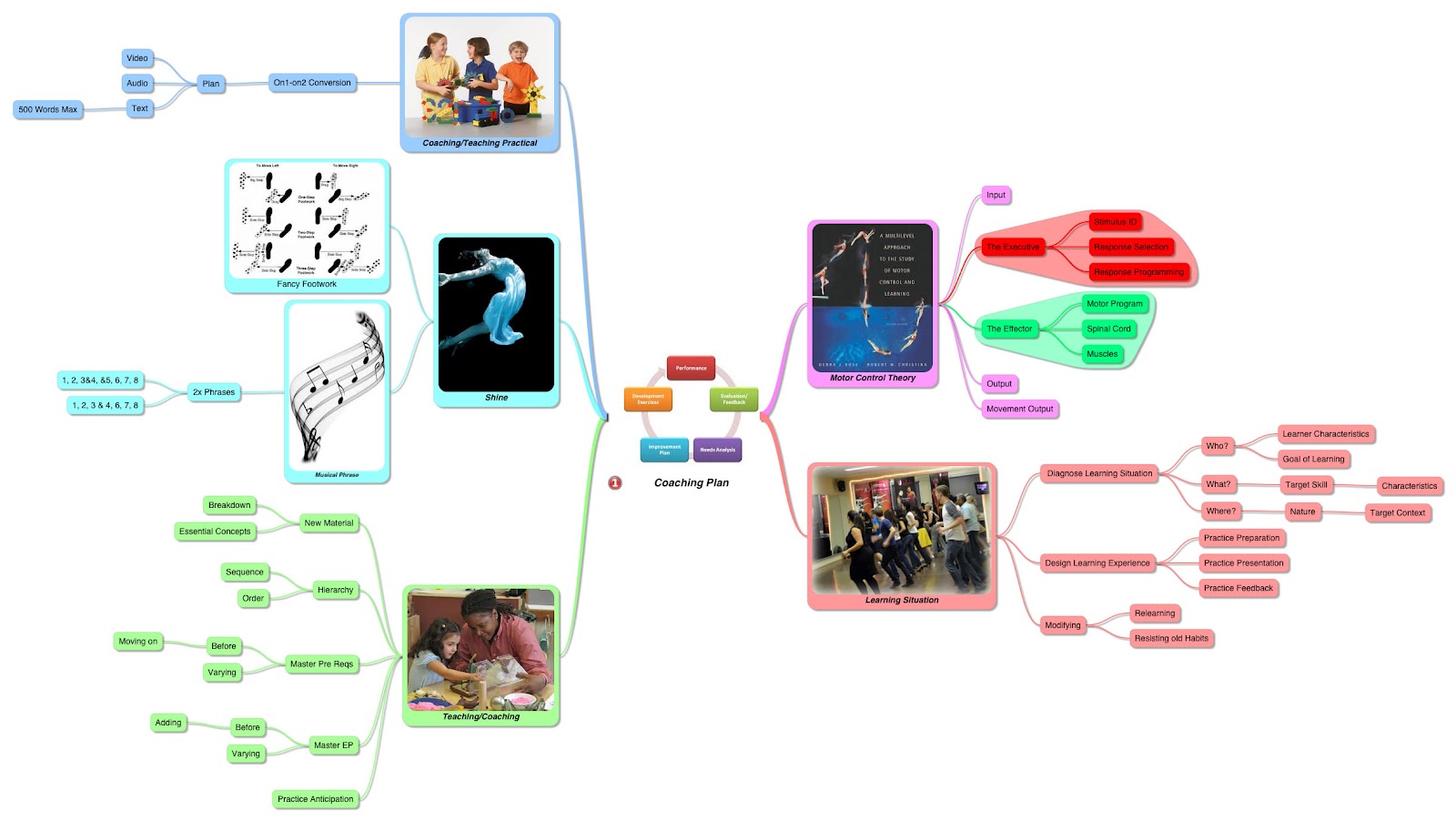
In the map adjacent, you can see that the Motor Program contains 5 main stages. In the 1st stage is The Input could be something as simple as cricket ball speeding towards you. The Stimulus Identification would be used to evaluate the environment, you would then respond or not which is the Response Selection and finally there would be a Response Program. The Response Program helps us to organise, plan and then send to the Motor Program. The Stimulus ID, Response Selection and Response Program are known as the Executive which are simply the stages we use to process information.
The Motor Program then begins to act on our Spinal cord and Muscles. The Motor Program, Spinal cord and the Muscles belong to what is known as the Effector which links the Motor Program to the Peripheral Motor System.
The final stage is the Output which will let us know whether we’ve been successful in defending the wicket or leaving the ball alone if wide or attacking the ball for that possible four. Note the word possible since once a decision is made, there will be a change in the environment meaning we hit, defend successfully or miss as intended or miss as in out. At that stage, information arriving at us is too late for us to do anything about it – the environment has changed.
When learning movements or a sequence of movements, the Motor Program can only do a short string of movements and with practice, longer sequences of movements can be initiated with better control and thus more skill full actions. When this sequence of moves has been learned, it is then stored into long term memory. When required, it is retrieved from short term memory within the Response Selection stage.
It is worth noting that there is an alternative to the Motor Control Theory known as Bernstein’s Dynamic Perspective (Bernstein, N.I 1967) but it is beyond the scope of this post to discuss.
Learning Situation
Ok, with the theory out of the way, let’s move onto the Learning Situation as shown on the mind map.
Diagnose the Learning Situation
· Who are the learners and their characteristics? Their goal of learning?
o Social dancers from all walks of life: students, singles, mum’s and dads, athletes, etc. Goal of learning is to learn on2. Various levels of on2 experience;
· What is their target skill and characteristics?
o The target skill involves learning a shine (fancy footwork) that involves 4 by 4 counts of musical timing. In salsa, this is known as 2 phrases of 8.
· Where is the nature of the target context?
o This is the dance step itself. It doesn’t involve partner dancing. The steps involve the familiar ‘basic’ within on2 but also fast timing footwork, torso and shoulder moves. The moves are to be executed within the musical timing however, the music chosen will be slow.
Design the Learning Experience
· Practice Preparation
o Students are presented the information (dance steps) slowly.
· Practice Presentation
o Students practice the dance steps.
· Practice Feedback
o Students are given opportunities to ask questions and provide feedback.
Modifying
· Relearning
o In a sense, students are relearning something that appears old (on1) to something that is quite new (on2). This can be quite difficult to overcome
· Resisting old Habits
o Old habits are learned from on1 dance timing. So the mind needs to make a ‘mind switch’ in order to be successful for on2. This links in with Relearning and resisting those old habits.
Coaching/Teaching Tips
On the map, we now move onto Coaching/Teaching Tips. These are all quite self-explanatory so I won’t spend too much time writing about them - this post is getting long!
New material must be broken down into essential concepts and must be presented in ordered fashion, known as a hierarchy of sequenced moves. The first moves must be mastered as pre requisites before moving onto the next dance step and certainly before varying those dance steps. It is essential to master the Executive Program (mentioned above in the Theory section) before adding new material and/or varying the material. Finally, practicing anticipation is vital to successfully executing the move. This means that waiting for the first beat of the musical phrase before moving will allow correct timing. Being in sync with the music does indeed make for a magical experience!
Conclusion
Usually in scientific reports, the conclusion isn’t used as a heading but what the heck; this isn’t a scientific report so I’ll use it as a heading!
The final sections in the map such as Shine and Coaching/Teaching Practical are hints that I need to do in order to have the shine plan and counting sequence required but also to draw on the video and written text requirements for passing the Unit Sport Coaching Pedagogy.
I realise that some of the coaching concepts such as presenting new and complex material at first glance by breaking it down may be a matter of common sense but sometimes common sense may be lacking. Theory with good evidence can help us move down that track of common sense and present us information that at first glance may appear quite puzzling but in reality, common sense applies.
Thanks for reading!
References
Bernstein, NI (1967). The coordination and regulation of movements. Oxford, England: Pergamon Press
Henry, FM (1961). Reaction time-movement time correlations. Perceptual and Motor Skills, 12, 63-66
Henry, FM (1968). Specificity vs. generality in learning motor skill. Classical Studies on Physical Activity (pp. 331-340) Perceptual and Motor Skills, 12, 63-66
Henry, FM & Rogers, DE (1960). Increased response latency for complicated movements and a “memory drum” theory of motor neuron reaction. Research Quarterly, 31, 448-458.